Cosmetic Pre-Shipment Inspection Checklist Before Shipping
A pre shipment inspection is a structured review of finished goods before they leave the supplier. For private label skincare and cosmetics, it compares selected production units, packaging, labeling, quantities and shipment cartons with the buyer’s approved specifications. The purpose is to give the brand, importer or distributor documented evidence for a ship, hold or escalate decision—not to repeat laboratory testing or replace the factory’s batch-release process.
This guide is for OEM/ODM cosmetic buyers preparing a practical inspection brief. AIYAN is an OEM/ODM skincare factory and export team that can coordinate product, packaging and order requirements with customers. It is not presented here as an independent third-party inspection agency. A buyer may conduct its own review, appoint an external inspector or agree a defined review process with the manufacturer.
What Is a Pre-Shipment Inspection?
In international purchasing, pre-shipment inspection generally means checking goods before dispatch to verify agreed characteristics such as quality and quantity. The WTO describes government-mandated pre-shipment inspection as verification that can cover quality, quantity, price or customs classification. For a private commercial order, the exact scope should come from the purchase agreement, controlled specifications and inspection brief.
A cosmetic pre shipment inspection normally asks four questions:
- Are these the correct finished products and quantities?
- Do selected units match the approved formula presentation, packaging and artwork references?
- Are the cartons and pack-out ready for the intended shipment method?
- Is the evidence sufficient for authorized representatives to decide what happens next?
It does not prove long-term stability, microbiological quality, regulatory compliance in every destination, or performance claims. Those conclusions require their own qualified evidence.
When Should the Inspection Take Place?
Schedule the review when the order is substantially complete, packed and available for representative selection, but before dispatch. If too little is finished, the sample may not represent the shipment. If the goods have already been loaded or released, corrective options become narrower and more expensive.
Before confirming the date, record the finished quantity, SKUs, variants, batch identifiers, packing status, carton locations, factory-side release status, approved references, inspection scope, sampling approach, report format and authorized decision makers. An inspection date is not evidence that production is complete; the report should state the actual population presented.
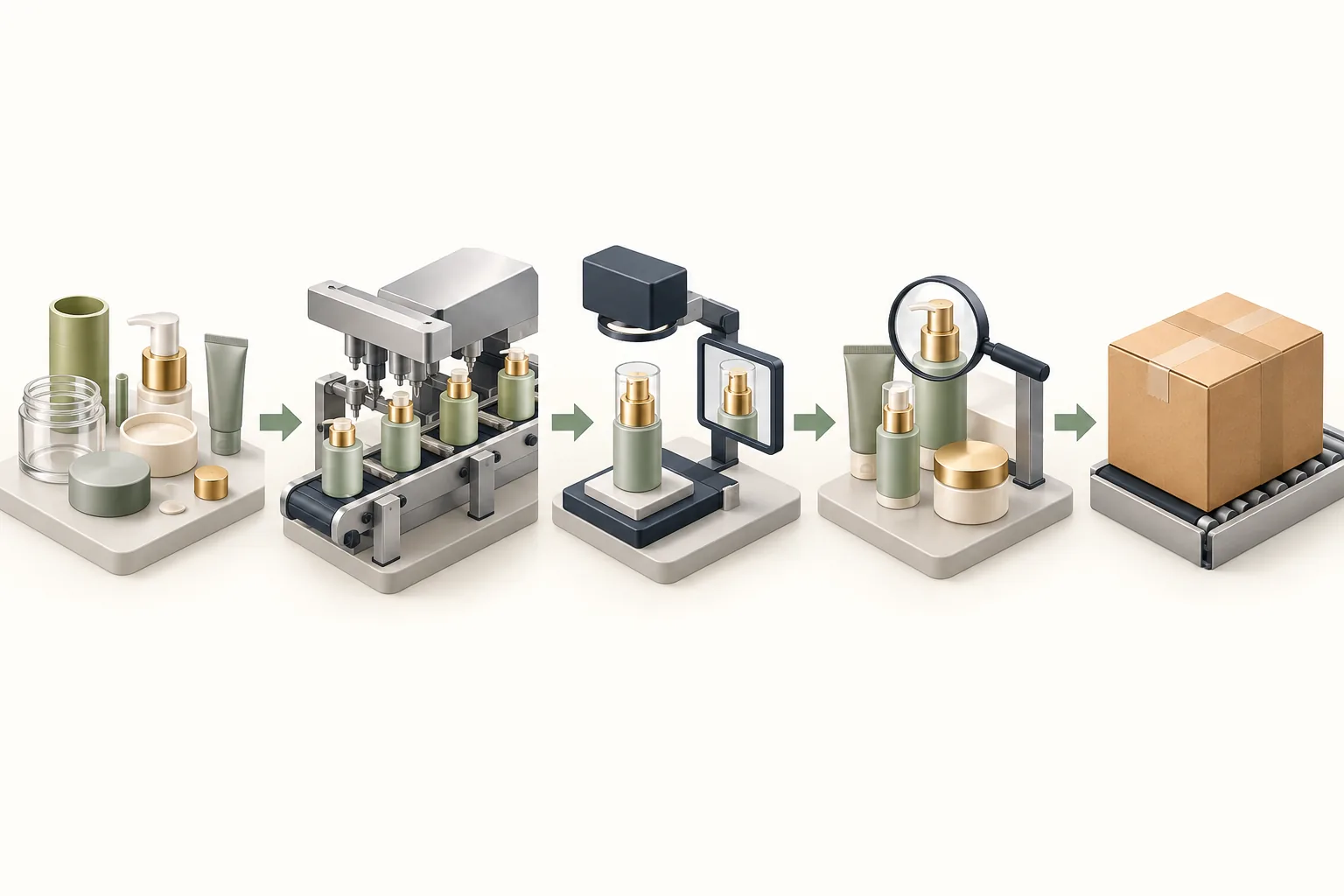
Pre-Shipment, During-Production and Container-Loading Checks
| Checkpoint | Timing | Main question | Typical evidence |
|---|---|---|---|
| During-production inspection | Manufacturing or packing is underway | Is the process producing the agreed product and pack configuration? | In-process observations, component checks and emerging defect patterns |
| Pre shipment inspection / final random inspection | Finished goods are available before dispatch | Do selected finished units and cartons match the approved order references? | Sample results, photographs, quantity reconciliation and defect records |
| Container loading check | During loading | Are approved goods, carton counts and loading conditions consistent with the shipping plan? | Container condition, seal details, carton count and loading photographs |
A container loading check cannot recover a missing artwork review. A final random inspection cannot replace controls that should have occurred during filling, assembly or coding. Buyers should select checkpoints according to product risk, order complexity and contractual responsibilities.
Factory Internal QC vs. Third-Party Inspection
Factory internal quality control forms part of manufacturing. It can include incoming-component checks, in-process controls, finished-product review and batch disposition against factory procedures and the agreed specification.
An independent third-party inspector is separately appointed to observe or test a defined shipment scope and report to the commissioning party. Independence, competence, sampling authority and reporting responsibilities should be confirmed in that service agreement.
The functions can complement each other, but they are not duplicates. A third-party report does not transfer the manufacturer’s production responsibilities, and internal QC does not automatically satisfy a buyer’s independent-verification requirement. AIYAN should be described as the OEM/ODM manufacturer and export coordinator—not as QIMA, TÜV or another independent inspection body.
Build the Inspection Brief Before Sampling
“Check the quality” is not an actionable instruction. The inspection pack should include:
- Purchase order, SKU list and expected quantities
- Current product and packaging specifications
- Approved physical sample or controlled reference images
- Final artwork files and print approvals
- Batch-code, date-code and case-marking requirements
- Packing method, case pack and shipping-mark requirements
- Defined functional and sensory comparison methods
- Agreed defect definitions and escalation rules
- Sampling plan, if one is contractually selected
- Required photographs and pre shipment inspection report format
- Contacts authorized to answer urgent questions
The private label skincare manufacturing process explains the preceding development and production stages. Use the cosmetic stability testing guide for questions that cannot be answered through a short finished-goods review.
Sampling and AQL: Define the Plan, Do Not Guess
Sampling lets a buyer review selected units from a larger shipment, but it does not guarantee that every unit is defect-free. ISO 28590 introduces the ISO 2859 family of attribute-sampling systems and explains that the appropriate system must be selected for the situation.
If AQL-based acceptance sampling is used, identify the shipment population, lot definition, standard and edition, inspection level, sample size, defect definitions, acceptance and rejection numbers, treatment of multiple SKUs, and rules for inaccessible or reworked goods.
Do not state only “AQL 2.5” or “AQL passed.” AQL is not a universal cosmetic safety threshold, and a single number does not explain the inspection level, defect class or decision rule. High-risk concerns may require separate controls under the agreed plan.
Representative selection should cover more than one carton location and all in-scope SKUs or variants. Record which cartons and units were selected, and disclose any part of the shipment that could not be accessed.
Pre Shipment Inspection Checklist for Cosmetics
This quality control inspection checklist can be adapted to the controlled specification for the order.
| Inspection area | What to verify | Evidence to record | Escalate when |
|---|---|---|---|
| Order identity | Product, SKU, size, variant, batch or lot | SKU and batch photos; specification reference | Identity or version cannot be confirmed |
| Quantity | Units per case, case count, SKU split and presented total | Count sheet and packing-list comparison | Shortage, overage or mixed-SKU discrepancy exists |
| Product appearance | Color, clarity/opacity, separation, particles and fill presentation | Controlled-lighting photos and approved reference | Unexpected change or possible contamination appears |
| Odor | Comparison with approved reference under the agreed method | Reviewer, method and result | Material or unexplained difference is observed |
| Texture/viscosity | Agreed comparative method; flow or consistency where appropriate | Method, relevant conditions and observations | Result is outside approved comparison criteria |
| Primary packaging | Correct bottle, tube, jar, cap, pump, dropper, wiper or liner | Component and assembly photographs | Wrong component, damage or missing part is found |
| Seal/leakage | Seal presence, closure engagement, leakage and exterior residue | Units tested, method and failures | Leakage, open seal or closure failure occurs |
| Dispensing function | Pump, spray, dropper, nozzle or tube operation | Units tested and number of failures | Agreed functional limit is exceeded |
| Labeling/artwork | Version, placement, legibility, language and required panels | Artwork version and close-up photos | Wrong version, missing panel or illegibility appears |
| Coding | Batch/lot code position, legibility and consistency | Code photos by SKU and batch | Code is absent, unreadable or inconsistent |
| Net content checks | Agreed unit-weight or fill-verification method | Instrument, method and sample results | Results fall outside agreed criteria |
| Retail cartons | Correct carton, inserts, orientation and condition | Open-case and closed-carton photos | Pack-out error or damage affects saleability |
| Master cartons | Case pack, shipping marks, closure, crushing or moisture | Carton IDs, counts and condition photos | Wrong marks or damage threatens shipment |
| Documents | Packing list, specification, release status and agreed records | Identifier, date and status | A required record is missing or contradictory |
Product Appearance, Odor and Viscosity Checks
Skincare product inspection may include observable and sensory comparisons, but the method must be limited and clear. Compare appearance under consistent lighting and record color, clarity, opacity, separation, particles and fill presentation. For odor, name the reference and avoid “smells fine.” For viscosity or texture, use the agreed comparative method; a casual squeeze or visual flow check is not equivalent to validated laboratory testing.
If a result is unexpected, isolate the observation and request qualified review. Do not turn a pre-shipment observation into a claim that the product is safe, stable or compliant.
Packaging, Seals and Dispensing Function
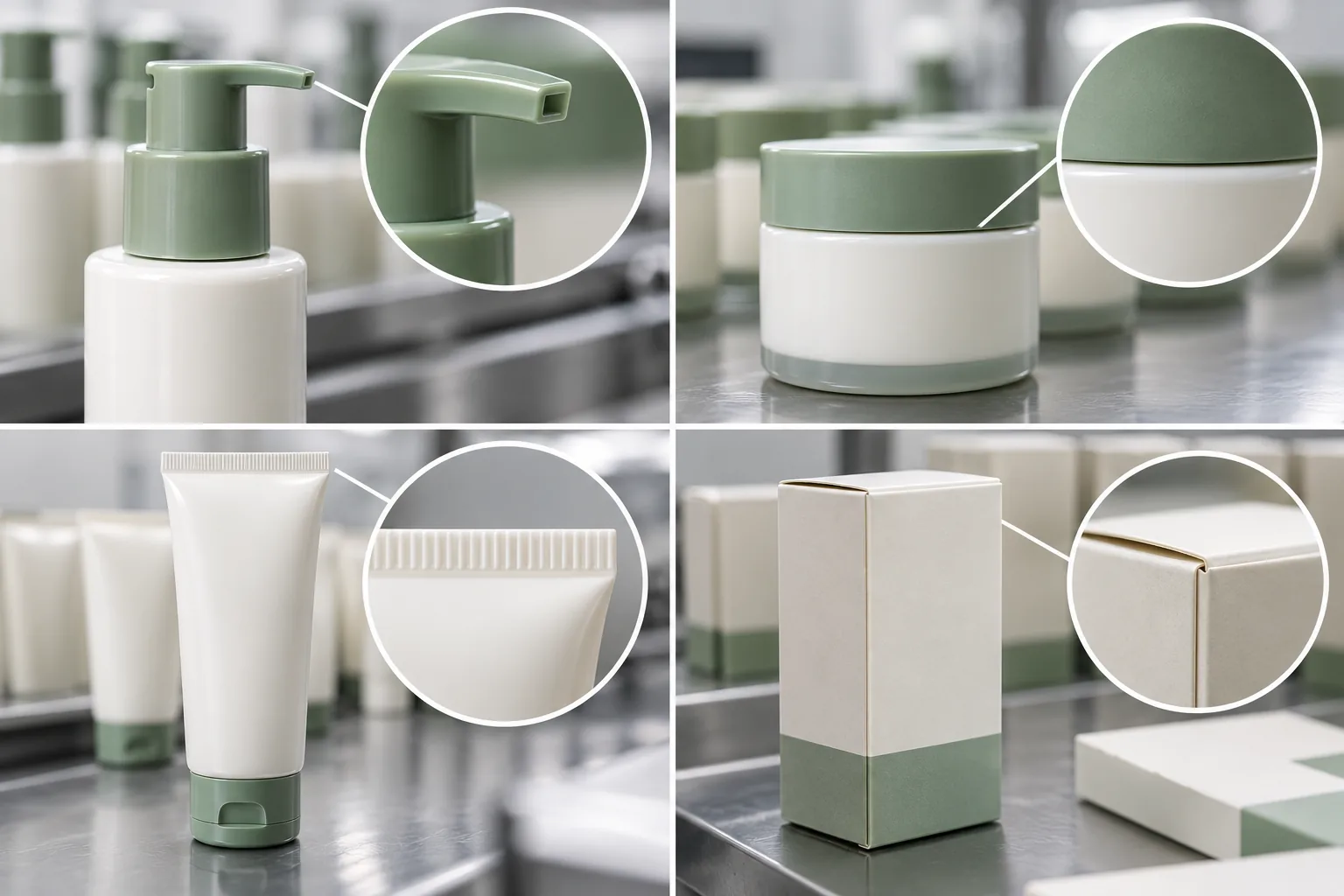
Check cap engagement; pump, sprayer, dropper, nozzle or tube operation; liner, gasket, wiper and tamper-feature presence; seal integrity; leakage; cracks or deformation; label alignment; and exterior residue. Record the number of units tested and failures by SKU. “Pump works” is incomplete without a sample count and method.
These checks assess finished units at that moment; they do not replace packaging compatibility work during development. For earlier selection principles, see the luxury skincare packaging guide.
Labeling, Batch Codes and Market Information
Compare every inspected label and carton with the final approved artwork. Check product identity, net quantity, ingredient panel, directions, warnings, responsible-party details, language, barcode and batch or lot coding required for the intended market.
For the United States, FDA guidance identifies product identity and an accurate net quantity statement as principal-display-panel requirements and specifies business information for the information panel. That guidance is a useful verification reference, but the brand or responsible party must still complete the market-specific legal review.
The inspection identifies mismatches; it is not a complete regulatory approval. Record the artwork version and photograph codes clearly enough for later review.
Quantity, Case Pack and Shipping Cartons
Reconcile the purchase order, packing list and population presented. Check finished quantity by SKU and batch, units per inner pack and master carton, carton count, mixed-case distribution, shipping marks, closure, reinforcement, crushing, puncture, moisture and pallet configuration when in scope.
A correct grand total can conceal an incorrect SKU split. Sampling selected cartons does not independently prove every carton count, so state the counting method and limitation.
What a Pre Shipment Inspection Report Should Include
| Report field | Required detail |
|---|---|
| Inspection identity | Date, location, reviewer and commissioning party |
| Order identity | PO, product, SKU, variant, batch/lot and artwork version |
| Population | Quantity and cartons presented; completion and packing status |
| Scope | Included and excluded checks, SKUs, batches and areas |
| References | Specifications, approved sample, artwork and packing documents |
| Sampling | Standard/plan if used, sample size and selection method |
| Results | Findings by SKU, check, defect category and observed quantity |
| Photographs | Traceable captions showing identity, result and location |
| Limitations | Inaccessible goods, missing records or unperformed checks |
| Corrective actions | Owner, required evidence and status |
| Recommendation | Ship, Hold or Escalate, with open issues visible |
| Final authorization | Named person or function recording the shipment decision |
Avoid a report that says “pass” while unresolved problems remain only in photographs or messages. Each deviation should identify the affected SKU, observed quantity, evidence and next action.
Decide: Ship, Hold or Escalate
Ship: The reviewed scope meets agreed criteria, evidence is available and authorized parties approve dispatch.
Hold: Affected goods remain controlled while missing information, correction, rework or additional review is completed. Identify affected SKUs, batches or cartons and the release authority.
Escalate: A technical, regulatory, safety, quality or commercial issue exceeds the reviewer’s authority. Send evidence to designated decision makers and prevent dispatch until the decision is documented.
The outcome applies only to the reviewed scope. It is not a guarantee covering uninspected units or unrelated regulatory responsibilities.

Quick Buyer Checklist
- ☐ Current PO, specifications, artwork and packing references are available.
- ☐ Finished population, SKUs, batches and carton locations are identified.
- ☐ Inspection timing and factory-side release status are recorded.
- ☐ Sampling plan and AQL terms, if used, are fully defined.
- ☐ Selected units cover agreed SKUs, batches and carton locations.
- ☐ Product identity, quantity and batch codes match the order.
- ☐ Appearance, odor and viscosity/texture use agreed methods.
- ☐ Closures, seals, pumps and dispensing functions are checked.
- ☐ Labels, artwork, barcodes and market information match approved files.
- ☐ Case packs, shipping marks and carton condition are reviewed.
- ☐ Findings are traceable to photographs and SKU references.
- ☐ Missing evidence and excluded checks are disclosed.
- ☐ Corrective actions have owners and evidence requirements.
- ☐ Ship, Hold or Escalate is recorded by an authorized decision maker.
Frequently Asked Questions
What is a pre shipment inspection?
It is a documented review of finished goods before dispatch. For cosmetics, it compares selected products, packaging, labeling, quantities and cartons with approved order references.
When should a pre shipment inspection be performed?
It should occur when enough finished and packed goods are available for representative selection, but before shipment. The report should disclose the completion percentage and quantity presented.
What should a cosmetic pre shipment inspection checklist include?
It should cover identity, sampling, quantity, appearance, odor, texture or viscosity, packaging function, seals, artwork, labeling, codes, cartons, documents, photographs and decision rules.
Is pre shipment inspection the same as batch release?
No. Batch release is manufacturing-side disposition against defined requirements. Pre shipment inspection is a buyer-side or independently commissioned review of selected finished goods and shipment evidence.
What is the difference between final random inspection and container loading inspection?
Final random inspection reviews selected finished units and cartons before dispatch. A loading inspection focuses on container condition, counts, identifiers and loading. One does not replace the other.
Does every cosmetic order use the same AQL?
No. The parties must select the standard, inspection level, defect definitions and acceptance rules for the product and contract. A generic AQL number is not a universal safety standard.
Can pre shipment inspection prove cosmetic safety or stability?
No. It can document visible condition and agreed functional checks for selected units. Safety, microbiological quality, stability and claim support require separate evidence.
Who makes the final shipping decision?
The agreement or quality plan should name the authorized decision maker. The reviewer supplies evidence and a recommendation; responsible buyer and manufacturer representatives document the final outcome.
Prepare the Inspection Scope Before Production Is Complete
A strong pre shipment inspection starts with controlled product, packaging and reporting requirements—not a generic pass/fail form. Define what must be checked, how samples will be selected, which evidence is required and who can authorize shipment.
AIYAN supports private label skincare brands, importers and distributors through its OEM/ODM factory and export team. Submit your product, packaging and inspection requirements so the team can discuss the specification, sample references, pack-out and shipment-review expectations for your project.